
Discovering my primary method of painting:
Unashamedly one summer, I watched a video on YouTube demonstrating an abstract art technique using cling film to create ‘flat’ texture. This didn’t have any immediate effect until I came to painting water in my second year in Aberystwyth. I explored a number of ways to imitate the the rippling, shimmering, stretching surface tension. It was at this point I tried drawing in fluid paint with the cling film. It served a few paintings well but something about the rigidity of the marks made things rather too static. I made further progress with it over the second half of the year. While painting I must admit I got slightly lazy with how I initially put paint on my sketching paper. I had made over a hundred small sketches with thinned down oils. In the ‘zone’ I placed one of the sheets directly onto my palette and peeled it off. This could well have come from my attempts at printmaking – I was taking a module on screen printing and lithography along side my painting studies. This lead on to me using the image itself to draw with, face down on the palette.
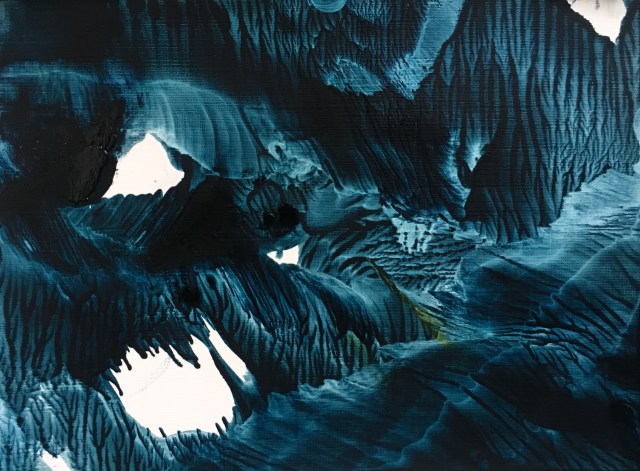
The lift, or reveal element of traditional printmaking techniques had inspired me so it wasn’t at all surprising that I took it into my painting practice. By varying the way in which I lift the paper from from the paint covered palette, I discovered many possibilities in texture and form, as well as being excitingly unpredictable.
When moving back to a canvas support, the technique lost favour with me for a simple reason, it became too predictable and deliberate. I like to paint on the edge of my skill set and use my tools to extend the capabilities of my imagination. The reason for the change in outcome was, when painting WITH the paper I was moving the painting around to create the image, while the painting tool stayed still. This didn’t work with the canvases and so I had hit a wall.
I made a significant development with the paper method. I found satisfying marks from the simplest of movements. Which brought me to a method of moving the paint around with a piece of wood – A piece of stretcher bar which had arrived in the post broken was fortunately knocking around my studio. I have tried single and multiple layers with this process and currently I am seeing how far I can push the leanness of the oil paint. I am using such thinned down paint for early layers that when the marks dry, the pigment reticulates in a similar manner to tusche in lithography. The pigment divides on the smooth surface resembling contour lines or wrinkly skin. I recently found out that only certain pigments separate like this, I intend to take this thought further and explore how other colours work if processed in a similar way. My methods of painting are continually shifting and growing in response to the individual painting’s requirements.

The most surprising discovery was producing the softest and most free marks were best achieved with the hardest objects – if executed in the correct manner.
 jonathanretallick.art